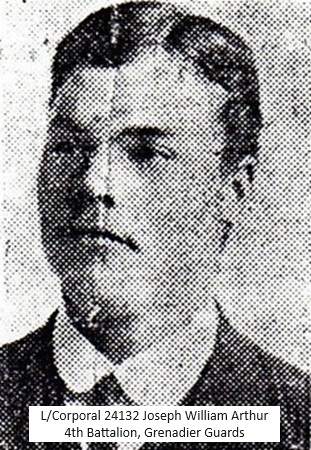
In the previous narrative of events dealing with Bourlon Wood and the attack on Fontaine, it was mentioned that the 4th Battalion Grenadier Guards was relieved by the 2nd Battalion Coldstream Guards on the night of the 27th of November.
Leaving Bourlon Wood the battalion marched back to the hindenburg line outside Flesquires skirting Anneux on the east and passing through La Justice thus avoiding the heavily shelled area on the West of ano where casualties had previously been sustained. After passing La Justice the enemy fired some gas shells and the Battalion marched for some distance in their gas masks. On the return march no casualties were sustained.
On the 28th of November the 3rd Guards Brigade marched to Trescault and at nightfall occupied tents which were pitched on some open ground between the Trescault – Metz Road and Havrincourt Road. Under orders of the Brigade Major, and for the purpose of avoiding aerial observation, the camp was struck on the following day, 29th, and repitched in Havrincourt itself. The weather was now perfect and proved to be the commencement of the fine spell that lasted throughout the battle. The spot selected was sheltered, and by nightfall the men will comfortably settled in - there was an abundance of wood available for braziers, and that night the campfires burned brightly along the South-Eastern fringes of Havrincourt Wood. The hardships endured in Bourlon Wood were forgotten, and all ranks were looking forward to being withdrawn to a back area for a rest.
Early on the 30th those who were awake heard the noise of a heavy bombardment coming from the east, but after their recent experience in Bourlon Wood paid no particular attention to it. The officers had completed their breakfasts, and inspections were in progress when at 9:20am an order arrived to stand to arms, and the reconnoitre a defensive position facing east. The enemy were reported to have broken through the British line near Gonnelieu. Hardly had the position been reconnoitred when a second order arrived at 11.45am for the Guards Division to concentrate at Metz, we're the 1st Guards Brigade lay bivouacked. The 3rd Guards Brigade fell in hastily and marched through Havrincourt to Metz. The roads were crowded with transport and as the Battalion passed through Metz a high velocity gun shelled the road in a disultory manner but inflicted no casualties.
Rumour was busy but definite news of any kind was withheld from the troops; probably the higher command itself was ignorant of the real situation. The Commanding Officer and 2nd in Command had read a message stating that the Germans had been seen marching in fours through Gouzeaucourt, a place of great importance since it was the railhead and the Headquarters of the 29th Division. More than this no one in the Battalion knew. Significant signs of a disaster were not absent, there was a total lack of gunfire, when did and unwounded without arms and equipment we're drifting back with incoherent stories, officers were seen in 1/2 dressed condition, heavy Gunners hurried past carrying the breach blocks of their guns.
The Brigadier and Commanding Officers of the brigade rode forward into Metz to try and glean some news. They saw a Corps staff officer but his information was of a confusing character and of no assistance. The 3rd Guards Brigade marched through Metz and out past the beetroot factory onto open ground and halted to await the result of the reconnaissance. At about 2.30pm the Brigade moved east in artillery formation the object being Gouzeaucourt. This objective in the meantime had been captured by the 1st Brigade who put to flight the German troops who were plundering the town. The direction of march was slightly changed for the rumoured purpose of a subsequent advance at dawn the next morning.
At about 5 o’clock on the 30th the 4th Battalion crossed the Trescault- Gouzeaucourt Road and Battalion Headquarters was established in a dugout on the road itself about 600 yards north of Gouzeaucourt. Companies rested in this area numbers 2-3 and four on the east of the road uh #1 on the road itself slightly north of Battalion Headquarters. The Trescault- Gouzeaucourt Road on the eastern side was honeycombed with dugouts previously occupied by Divisional R.E. and R.F.A. One of these was selected as Battalion Headquarters. The occupants had apparently evacuated their positions in a great hurry, as all their personal articles were lying about in the greatest confusion.
About 6.30pm that evening the cookers, which had been following the battalion as far as it was practicable, arrived and the men were provided with hot food; it is doubtful if any of the other units taking part in the action outside the Division were in such an enviable position. The Brigadier of the 16th Brigade of the 6th Division (General Walker) appeared at the battalion headquarters at about 11pm and informed us that his Brigade was under orders to attack Gonnelieu at 1am the following morning. As the 4th battalion Grenadier Guards was intimately affected by the result of their attack, he suggested holding his conference at our Battalion Headquarters. This conference took place, all the Commanding Officers of his Brigade being present. It was agreed we should be advised of the result of the attack.
The hurried manner in which the attack was organised, the patent lack of information on which it was based made it clear it was most unlikely to succeed. At 1am on 1st Dec a warning order arrived that in the event of failure of the attack the 16th Brigade, the 3rd Guards Brigade would assault Gonnelieu at 6.30am. The Commanding Officer was verbally instructed to arrange the parties to attack in conjunction with the commanding officer of the 1st Welsh Guards. Some time later an officer commanding a battery of tanks reported to say that the attack would be supported by 12 tanks. The Commanding Officer called in his company commanders to a conference and explained the situation to them.
With the most meagre information and orders at his disposal he proceeded in conjunction with the Commanding Officers 1st Welsh Guards to form his plans and write orders for the contemplated attack. It is important to bear in mind the following points which vitally affect the subsequent events.
The time allowed between the reception of the initial warning for attack and the attack itself was totally inadequate.
The brigade major, after the attack on Fontaine, had been sent on leave therefore the Brigade was very much understaffed and unable to render the assistance to Battalions which could have been expected at ordinary times.
The hurried move from Trescault for an indefinite destination made the Quartermaster's difficulties very great, also those of the Q branch of the Brigade.
The selection of a definite objective after dark making any kind of personal reconnaissance difficult, put a physical strain on the Commanding Officer which was intolerable. The whole planning of the attack, the writing of the orders, the conferences with the 16th Brigade and his own company commanders all had to be carried out in a space of four hours. The final dispositions depended on the attack of the 16th Brigade, which in any event was certain to leave an indefinite frontline and the result of the attack could not be known until a very short time before zero hour.
If the 16th Brigade attack succeeded the 3rd Guards Brigade had to relieve them, if it failed then the attack had to be made. These qualifications alone necessitated the working out of two alternative schemes. The Commanding Officer prepared in detail for the worst eventuality of the two. The plans were based on the use of tanks in conjunction with some artillery preparation.
It was clearly realised at Battalion Headquarters (Bn HQ) that the brigade was to be used in a manner now accepted as impossible except in great emergency, namely as a force of infantry without guns advancing across the open against an enemy occupying A trench system and groups of houses bristling with machine guns and supported by artillery. The emergency had arisen, the tanks water supply the lack of sufficient artillery.
Eventually news arrived of the failure of the attack of the 16th Brigade, the report of failure was clear, the information as to the new positions occupied entirely vague. The moment had arrived for the final preparations.
Battalion Headquarters moved through Gouzeaucourt on the sunken road between Gouzeaucourt and Villers Plouch, occupying a dug out on the eastern side of the road about 500 yards north of Gouzeaucourt. The companies preceded battalion headquarters, 2,3 & 4 companies crossed the Villers Plouch Road and deploying dug themselves in on the Gonnelieu side of the railway, facing that village. No 1 company remained in the sunken road spread out on both sides of Battalion Headquarters.
A further conference of company commanders was held at the new Battalion Headquarters and the Commanding Officer (CO) superintended a readjustment of the line with the object of maintaining direction when the advance commenced. The order of attack for the battalion was, 3 on the left, 2 on the right, 4 in support and 1 in reserve. The orders for the attack were issued at 3.15am on the 1st Dec and Zero hour was fixed for 6.30am on the same date.
The 3rd Guards Brigade order of battle was – Welsh Guards on the right, 4th Battalion Grenadier Guards on the left, 1st Battalion Grenadier Guards was employed in support to carry out the special role of protecting the left flank of the attack if threatened. The 2nd Battalion Scot Guards had previously moved up to hold the high ground about Villers Plouch and occupied a position some 1500 yards to the north of the point of assembly of the 4th Battalion. The 1st Guards Brigade attacked at the same time on the right flank of the 3rd Guards Brigade.
At 6.15am the Intelligence Officer with the forward party was sent to take up a position in a trench 300 yards in advance of Battalion HQ.