
South Warwickshire Family History Society War Memorial Transcription Project
The Fallen Men of South Warwickshire - World War One |
|
1s
|

|
Military History |
| Theatre of War | Medals | Commonwealth War Grave or Memorial |
|---|---|---|
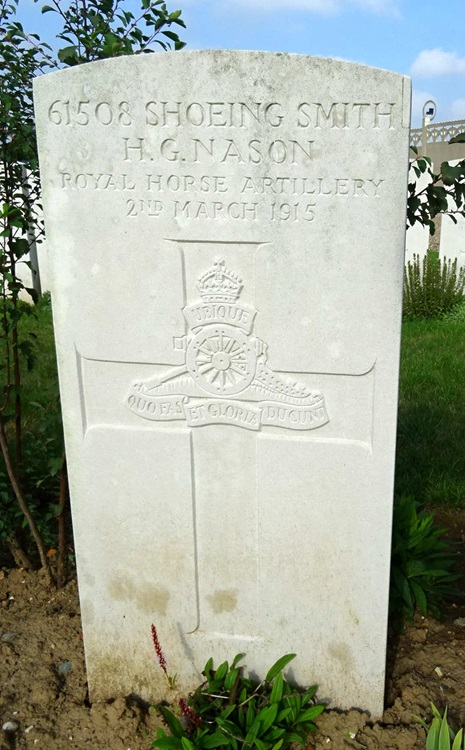
| France and Flanders | 1914-15 Star, British War & Victory Medals | Aire Communal Cemetery |
| Arrived in Theatre | Medal Citation (if app) | SWFHS Area Memorials |
| 10 Dec 1914 in | ~ | Shipston on Stour |
| Shipston Council School | ||
| Action, Battle or Other Reason Killed | Date and Place Enlisted | |
| Accidentally Killed in explosion | 1 Jun 1908 at Birmingham | |
| Place of Death | Previous Regiments or Units | Other War Memorials |
| Serny | ~ | |
Prior Military Service
Per Stratford Herald and Evesham Journal - enlisted in 1908 and spent 5 years in India (c1909 to November 1914)
Circumstances of Death
|
Herbert is listed as being killed on 2 Mar 1915, he was accidentally killed during a trench mortar practise, see below. During the incident that led to his death 7 men were killed outright, 7 officers and men later died of wounds and a further 35 were wounded to some extent. As a result there was a Board of Enquiry the findings of which are held by the National Archives under reference WO 364 - First World War Pension Claims. The findings are transcribed below and we think that the page containing the conclusions of the Board is missing. Proceedings of a Board held at Croix Barbee on the 15th Day of March 1915, by order of M.Gen G.A. Cookson, C.B. Commanding 2nd Indian Cavalry Division, for a purpose of enquiring into the cause of accident that occurred in V Battery R.H.A., on the 2nd March 1915 The Board having assembled at 5.30pm proceed to take evidence. 1st Witness Testimony - 2nd Lt Gray2/Lt Wingate Gray - V Battery R.H. states: At Serny on the 2nd March about 2.30pm we were practicing firing with a trench mortar which had recently been issued to the battery. We had successfully fired the mortar three times, and on each occasion we considered the fuse in the bomb was too long. Previous to firing the fourth shot Major Goldie cut the fuse down as short as possible. The plug and the detonator were fixed in the bomb and carefully sealed in with plasticive. The bomb was then loaded in the usual manner. The fuze igniting the charge – about 4″ long, was then lit, and I cautioned those standing round to stand clear. A terrific explosion followed. I realized at once what had happened – viz, a premature in the bore – and saw a number of men wounded on the ground. It was subsequently ascertained that six men were killed outright and seven died of wounds including Major Goldie and 2nd Lieut Purchas. There were thirty five men wounded it total, some of whom are still in hospital, a few having returned to the Battery. I consider the cause of the premature was due to the time fuze in the bomb being cut too short, thus causing the quick match to become exposed to the flash of the powder charge. It might possibly have occurred owing to the imperfect plasticive sealing if the wooden plug, although it was carefully inspected before loading by Major Goldie and myself. 2nd Witness Testimony - A/B.S.M. MorleyA/B.S.M. Morley V Battery R.H. states: “On the 2nd March 1915, about 2pm, the whole battery paraded to see the trench mortar fired. It was successfully fired three times and each time the bomb fell to the ground but did not explode for several seconds. Previous to firing the fourth round, in order to obtain a burst immediately the bomb touched the ground, Major Goldie cut the fuze down as close as possible top the wooden plug. The mortar having been loaded in the usual manner, the whole battery was cautioned to stand back before lighting the powder fuse. Immediately the fuze reached the powder charge there was a slight report and after a few seconds, thinking that it was a miss-fire, all the men closed in. As soon as they got within a few yards there was a violent explosion and several then fell to the ground. 3rd Witness Testimony - Sergeant WatkinsSergeant Morley V Battery R.H. states: At 2pm I was warned to parade my men to see the mortar fired. I was standing close by and saw everything that was going on. The first three rounds were successfully fired. The fourth round was prepared in an exactly similar manner to the previous rounds, with the exception that Major Goldie himself cut the bomb fuse down as short as possible. The mortar was loaded with the smallest charge on the range table, and the bomb loaded in the usual way. CasualtiesRoll of Officers, N.C.O's and men of V Battery R.H.A., killed and wounded by the accident to trench mortar on the 2nd March 1915. Killed Outright. 56825, a/Bdr N. Fielding Died of Wounds. Major L M Goldie MVO, DSO; Wounded. 51954 Gnr H Gowen, 64167 Gnr J Sivers, 51189 Gnr J Middleton, 38165 Dvr J Parker, 41803 Sgt R Beaver, 53681 A/Bdr J Pole, 43047 Sgt J Perry, 69414 Dvr J Ledger, 51190 A/Bdr C McGrath, 25915 Battery Sergeant Major A Rumley, 67895 Dvr H White, 63108 Gnr W Blaydon, 59532 Dvr G Warner, 51681 Gne A Whiddett, 55807 Dvr R Jarvis, 50415 Dvr C Bishop, 43537 Gnr B Galpin, 50795 Dvr W Thompson, 52808 Dvr R Day, 54923 Dvr G Elmer, 55612 Dvr J Luck, 52838 Gnr F Marchant, 78090 Dvr H Mylam, 2nd Lt P M Hosack. Wounded and Rejoined Unit. 48150 Gnr G Saville, 57658 Gnr C Long |
| Personal & Family History |
| Birth Date/Place | Baptism Date/Place |
|---|---|
| Apr Qtr 1887 at Barcheson | 3 Apr 1887 at Barcheson |
| Parents Names | Abode |
| William and Emma Nason | Shipston-on-Stour |
| Schools | Colleges |
| Shipston Council School 1890 to 1900 | ~ |
| Address History | Employment History |
| 1887 - Barcheson | 1890 - Scholar at Infant School |
| 1890 - West Street, Shipston on Stour | 1894 - Scholar at Junior School |
| 1891 - Church Street, Shipston on Stour | 1901 - Blacksmiths Apprentice |
| 1901 - Barton House, Blockley, Shipston | 1911 - Driver in Royal Horse Artillery |
| 1911 - Wellington Lines Barracks, Aldershot | 1914 - Shoeing Smith in Royal Horse Artillery |
| 1914 - Army Barracks, Meerut, India | |
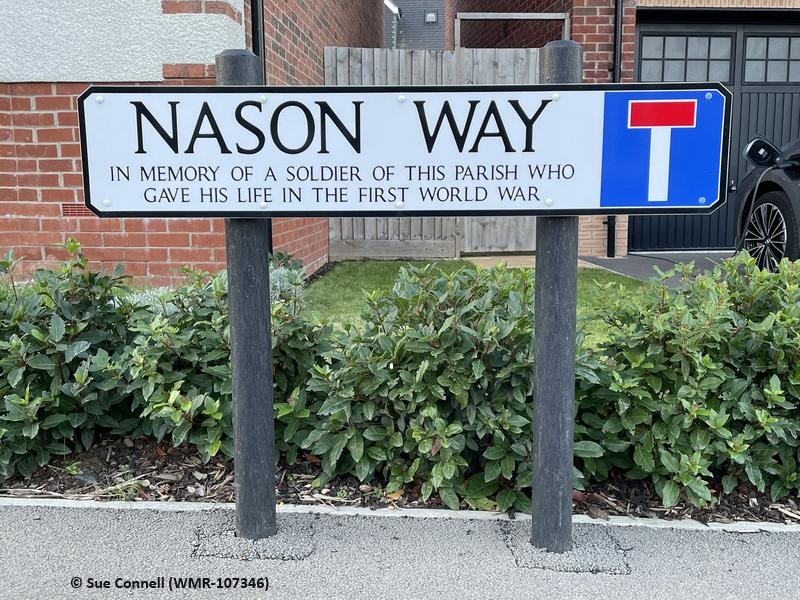
Shipston on Stour Street Signs
Nason Way in Shipston on Stour is named in Herbert's memory
Click to enlarge